

Shuttles That Keep Shift Teams Moving on Time
Employee shuttles for factories, warehouses, construction sites, NHS rotas, airport staff, and early or late shifts—compare licensed UK operators for contract staff transport.
How Does It Work?

Submit Your Request
Share your trip on the platform. It takes about a minute and costs nothing.

Compare Prices & Services
Operators send you their offers. Compare the prices, vehicles and reviews in one place.

Choose Your Carrier
Pick the operator that suits you and confirm. From there, they handle the journey.
Shuttles That Keep Shift Teams Moving on Time
Factory, warehouse, and construction shuttles when shift change cannot slip

A production line doesn't wait. Neither does a pick tower or a site gate. The shift starts when it starts, and staff shuttle transport coach and minibus hire exists so that a whole crew clocks in together instead of trickling through the turnstiles after a missed connection or a car share that fell apart overnight. One vehicle on one route, arriving inside a window an operations planner can actually track, measure and adjust. Where a factory runs 06:00, 14:00 and 22:00 starts, the timetable gets built backwards from the clock-in deadline, with boarding points sequenced so the last pick-up still lands everyone at the gate in time to change, sign in and take the handover briefing. That discipline is what makes a genuine shift shuttle, as opposed to a one-off coach booking with ambitions.
Warehouse and fulfilment parks tend to sit where land is cheap and buses are rare, which quietly shrinks recruitment to people who drive. A contracted shuttle turns that around. HR maps employee postcodes, clusters them into two or three feeder routes, and connects the estate to the towns where applicants actually live. Run it as ongoing contract transport and the service gains a fixed timetable, familiar drivers and a cost per shift that finance can budget against for the whole year. Three numbers usually carry the business case: vacancy fill rates, lateness at shift change, and attrition among staff without cars. All three move once a door-to-gate journey replaces a two-change commute that ends with a long walk down an unlit estate road.
Construction brings its own headaches. Compounds move. Muster points shift as phases complete, and a workforce drawn from several trades rarely lives in one place. The usual answer is a shuttle running between a park-and-ride field or a nearby transport hub and the site compound, timed to induction and briefing slots rather than a generic morning peak. Because vehicles return to a known stand, PPE and tool storage stays manageable, and the site manager gets a reliable headcount before anyone works at height or inside an exclusion zone. On longer builds the route gets reviewed at each phase gate. The same contract then flexes as groundworks give way to structure and then fit-out, with no need to retender the transport each time the programme changes shape.
Vehicle size drives cost more than anything else in the deal. A 16-seat minibus suits a single team or a quiet night shift; coaches of 33 to 53 seats move a full shift change in one go; very large sites often pair the two, with a minibus sweeping outlying villages onto a trunk coach route. Overfilling doesn't work, since standing passengers aren't permitted on contracted road transport, and a half-empty 70-seater wastes budget on every single departure of a multi-year agreement. Operators quoting through 1Bus.co.uk will normally ask for ridership by shift rather than raw headcount, because a four-hundred-person site with staggered starts can need far fewer seats per run than the total suggests. Overtime patterns and weekend working change the answer too, so share the rota, not just the headcount.
Planning a first service is simpler when the brief is honest. Map where staff really live. Pick boarding points with safe waiting areas and decent lighting, then set a trial period with a review after four to eight weeks so the timetable gets corrected against real boarding data, not assumptions. Decide early who pays; fully employer-funded shuttles get the highest take-up, though subsidised fares still compare well against the cost of expanding car parking on most sites. And treat punctuality as a contractual measure with teeth. A shuttle arriving at five past the hour isn't a transport inconvenience. It's a production problem, a picking-rate problem, or a concrete pour that misses its window, and the service level agreement should say so in plain, enforceable terms.
NHS rotas, airport staff, and contract crews on unsociable hours
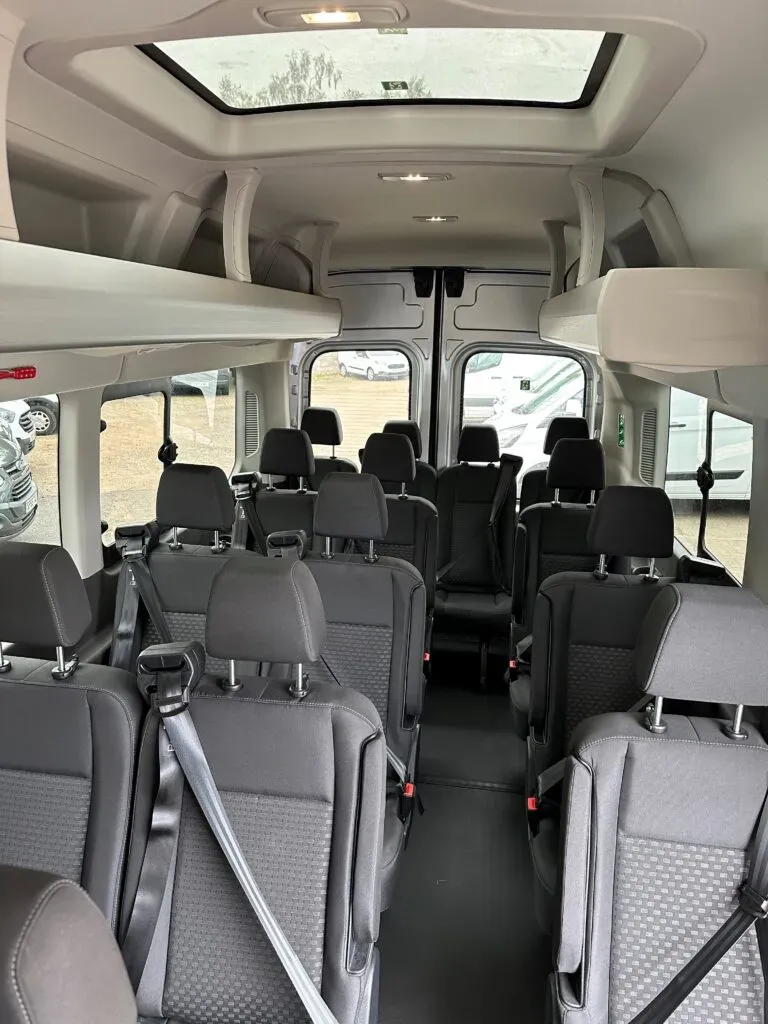
Hospitals never close, so workforce transport has to hold up around the clock. When an NHS trust commissions a staff shuttle it's usually solving three problems at once: night rota staff finishing after the last scheduled bus has gone, car parks that fill before the day shift even arrives, and clinical teams split across two or more sites who need to swap people mid-shift without running a taxi account. A dedicated shuttle linking a park-and-ride site, the main hospital and the satellite clinics keeps clinical cover predictable and frees patient-facing parking for the people it was built for. Trusts already commissioning healthcare and care transport for patients often extend the same operator relationship to staff movement, since the compliance groundwork on insurance, driver checks and vehicle standards carries straight across. Scheduling detail matters more here than almost anywhere else. Ward handovers happen at fixed times, so a timetable built around the 07:30 and 19:30 handover windows wins the confidence of clinical staff in a way a generic hourly loop never will, however frequently it runs. Rotas rotate through weekends and bank holidays as well, so the timetable has to rotate with them, backed by a named contact who can authorise short-notice changes when wards flex and demand moves. Ask for boarding counts by run in the monthly report; within weeks they show whether the park-and-ride leg or the inter-site leg is doing the real work.
Airports concentrate the same problem at far greater scale. Security officers, baggage handlers, retail staff and cabin crews all report before the earliest departures, which pushes the workforce arrival peak to roughly 03:30 to 04:30. Exactly the hours when public transport is thinnest and staff parking charges sting hardest. Employer and consortium shuttles running in from the surrounding towns fill that gap, with ID-controlled boarding where the airport requires it and set-down at staff gates instead of passenger forecourts. The operators involved may also run passenger airport transfers, but a staff shuttle is a different product on paper: it repeats every day of the year, it's timed to report times rather than flight times, and it has to keep going through the December peak and the summer surge when everything else is stretched. Ground handlers tendering for new airport contracts increasingly write committed staff transport into their bids. Recruiters know an applicant without a car simply can't accept a 04:00 start otherwise, and absence rates on the earliest report times drop measurably once a guaranteed seat exists. The same logic covers seasonal recruitment drives, where a promised shuttle place can decide whether a peak roster gets filled or runs short through the busiest weeks of the year.
Beyond hospitals and airports sit the quieter unsociable-hours crews: contract cleaners heading into office districts before 05:00, hospitality teams finishing after midnight, engineering gangs on overnight road and rail possessions. The legal framework is the same for all of them. Vehicles run under a PSV operator licence, drivers work within drivers' hours rules, and the insurance matches contracted work; that framework is what separates a professional shuttle from informal van-sharing arranged around a rota. There's also a duty-of-care question that deserves straight treatment. Putting a fatigued night worker into a professional driver's vehicle at 06:00, instead of behind their own wheel, is a risk decision rather than a perk, and health and safety teams increasingly treat it as one. The practical advice holds across every sector working odd hours. Contract for the pattern genuinely worked, weekends and bank holidays included. Agree in writing how short-notice rota changes get notified and priced. Insist on a named escalation route for the mornings when weather, roadworks or a vehicle defect threatens the day's first departure. Those three clauses cost nothing to include at tender stage and save arguments for years afterwards.
Employee shuttle contracts and comparing operators on 1Bus.co.uk

Comparing shuttle operators used to mean weeks of unanswered emails and quotes that each priced something slightly different. 1Bus.co.uk compresses that into one structured brief: sites and boarding points, shift times and days worked, estimated ridership per departure, accessibility requirements, and any site access rules such as inductions or ID checks. Licensed operators respond against the same specification, so quotes get compared line by line rather than decoded one by one. For what is, over a multi-year term, a significant procurement, that turns the exercise genuinely competitive without the buyer needing prior knowledge of the coach and minibus market. Expect to give real numbers rather than a guess; a brief that says forty a shift and thirty on Sundays gets sharper quotes than one that says various. HR managers, facilities teams and operations planners keep full control of the decision. The platform just removes the legwork of finding, briefing and chasing operators one at a time.
Contract structure deserves as much attention as price. Most employee shuttle agreements run for twelve to thirty-six months with scheduled review points, enough certainty for the operator to commit vehicles and drivers while the employer keeps room to adjust routes as the workforce changes. Build in the right to flex vehicle size against boarding data. Agree how fuel and wage movements get handled at review rather than mid-term, and define what happens if a site opens, closes or changes its shift pattern. Organisations that already buy corporate transport for meetings and events often fold the two agreements into one supplier relationship, which simplifies invoicing and gives the shuttle contract more commercial weight. The strongest agreements name their measures too: punctuality against the timetable, ridership reporting, vehicle presentation, and a remedy path both sides understand before anything goes wrong.
Resilience is the part of a specification most often left implicit, and it never should be. Ask every quoting operator what happens when a vehicle fails at 04:45. How fast does a replacement arrive, where does it come from, who tells the site? Operators who also deliver rail replacement work tend to answer convincingly, because that sector demands rapid mobilisation of vehicles and drivers at awkward hours and short notice. Written continuity arrangements belong in the contract itself, not in a reassuring chat during the sales process: spare vehicle cover, driver standby, and a communication tree that reaches the shift manager directly instead of a generic inbox. A shuttle that fails once on a payday Friday night shift does more damage to staff confidence than months of punctual running can repair. So the recovery plan deserves at least the same scrutiny as the timetable. Arguably more, since it's the part of the service nobody sees until it's suddenly the only part that matters.
Budgeting gets easier once the real cost drivers are on the table. Quotes reflect route mileage and running time, dead mileage out of the operator's depot, vehicle size and age, unsociable-hours driving, and how long and how certain the commitment is; a settled multi-year contract on a sensible route will always price differently from a speculative six-week trial. Skip the headline rate. Compare the cost per seat per shift across realistic ridership instead, and weigh it against what the business currently spends on parking pressure, lateness, unfilled vacancies and taxi fallbacks. To move forward, publish the brief with honest numbers, shortlist the operators whose answers show genuine shift-work experience, and run a defined trial with a review date. The employers who get lasting value treat staff shuttles as core operational infrastructure, specified, measured and renewed on evidence, not as a perk to be quietly switched off at the first tough budget review of the year.
Staff shuttle contract quotes
Scheduled employee transport between sites, shifts and remote car parks

Contract transport is not one-off event hire. It's the same route, run the same way, every week. Organisations lean on it when the journeys keep repeating: daily school runs, staff shuttles between sites, commuter links, care-home appointments, hotel crew transfers, feeder buses from a car park that sits miles from the gate. Book it as a contract and you get a fixed timetable, named vehicles and an operator you can hold to real KPIs instead of chasing excuses.
Contract transport fits almost any repeating pattern. Shift workers heading to a distribution hub. NHS staff moving between hospitals and remote parking. Hotel teams on a rolling rota. Residents who need to reach appointments on time. A multi-month agreement keeps budgeting predictable and spares you the admin of rebooking the same journey forty times over, and it gives the operator room to learn the route before anyone depends on it. So the dedicated services tend to run best on a proper contract: school transport has to survive term-time peaks, staff shuttle transport lives or dies on shift timing, and corporate transport wants one governed framework rather than scattered bookings.
On 1Bus.co.uk, contract enquiries go to operators who actually run scheduled services, not firms that treat every request as a single trip. You set the timetable, the vehicle sizes, the accessibility requirements and the contract length; we match you with vetted coach and minibus partners who already know term-time peaks, shift changes and punctuality reporting. For a lot of organisations that beats running your own fleet or piecing together ad-hoc bookings every week. Tell us what you need on the contract request form (routes, passenger numbers, contract length, access requirements) and we'll put you in front of operators ready to run it long term.
Our Vehicles

8 Seater Minibus
Flexible option for small groups, airport runs and luggage.

16 Seater Minibus
Perfect for medium groups and city travel.

39 Seater Midi Coach
Ideal for school trips, events, and local transport.

60 Seater Coach
Spacious and comfortable for long journeys and large groups.
Coach Hire and Minibus Hire with Driver

One-way or Return Transfers
Clean, well-kept vehicles for one-way or return trips. Plan a group journey in minutes with operators you can check first.

Train Station and Airport Transfers
Airport and station runs timed around your flight or train, at a price you can actually compare.

Hire Bus and Minibus per Hour
Need flexibility? Book a driver and vehicle by the hour, for any group size or occasion.

Complex Journeys
Multi-stop days, sightseeing, corporate itineraries: hire a bus or minibus with a driver and let them handle the route.
Sort your group travel in one go with 1bus.co.uk. Pick the service that fits and get quotes today.
Register NowWhy Choose 1Bus.co.uk?
Save Time
Skip the endless calls and email chains. Post your request in under a minute and let operators come to you with their best price.
Compare & Choose
Line up several quotes side by side. Weigh the price, the vehicle and the reviews, then pick the operator that actually fits the trip.
Free Service
The platform is free to use. No sign-up fee, nothing hidden. You only pay the operator once you confirm the booking.
Trusted Professionals
Operators apply to join and share their licence details before they go live. Real customer reviews help you spot the ones who turn up on time.
Friendly Support
Stuck on something? Our support team answers real questions from real people, no bot loop.
Eco-Friendly Travel
One coach takes a lot of cars off the road. Booking a group vehicle through 1bus.co.uk beats everyone driving separately.